Friday, April 25, 2014

Robot Apocalypse Update


I saw a google self driving car for the first time about a year ago.  The guy in the "driver's" seat was blissfully napping.  But it was a wake up call for me.  A crucial boundary between the computer world and my "meat" world is being breeched. The robots are here.   

This whole robots running around, willy nilly, thing makes me a little nervous.  But should it?  We've already lived among them in our online interactions.  We are on their turf online; peering through a tiny window into a world built for them.  On one hand they are helpers.  They try to understand what we are saying.  They help us look for things.   And on the other hand they also spy on us, and use our virtual identities in ways we might prefer that they didn't.  And as we started carrying them in our pockets, computers have extended their reach.  Now they can keep abreast of what we're doing, and interject themselves into our daily activities wherever we go.

But its a whole other thing when Frank Baum's Tic Toc starts autonymously helping (and spying) on our turf, in meat space.  That's where we live.  That's how AI jumps from the screen into our lives.

Shane Legg, one of the founders of DeepMind, the AI company Google just bought for $400M, summed it up this way.

“Eventually, I think human extinction will probably occur, and technology will likely play a part in this,” Mr. Legg said. “If a super-intelligent machine (or any kind of super-intelligent agent) decided to get rid of us, I think it would do so pretty efficiently.”

Google has established an ethics board to oversee their AI work.  I think that that's good news.  But maybe its a dangerous indicator, too?  Or is this all just the same sort of anxiety about an uncertain future that Chaplin was expressing in Modern Times?

Oh, and here are some cool robot videos.  Welcome to meat space, guys!

Wednesday, February 12, 2014

Visiting the Autodesk/Instructables Workshop with Artist in Residence Alejandro Palandjoglou


The other day I got to catch up with my friend, and former Stanford TA, Ale Palandjoglou.  You might recall me bragging on him when he won the Core 77 Design Award for Social Impact.  Now he's working as an artist in residence at Instructables.  He's one of the many brilliant folks there who are figuring out just what exactly we're supposed to do with the new capabilities that computer controlled making machines have brought us.  Here's Ale with a REALLY big CNC machine.  Really, really big.


Here are some tasteful and good sitting simple chairs that Ale designed for CNC router construction.  A good sitting chair is a beautiful thing, and no mean feat to achieve.  I like chairs that look like chairs!
This is another project Ale worked on--3D printed pictures!  It gets thicker where where it should be dark and gets thinner where it should be light.  That way when you hold it up to the light, it looks like the picture below.


Here are some laser cut records.  You know, the kind you drop a needle on.  I didn't get to take a listen, but I'm intrigued for sure!


 Robot drums, because they can.


In the cube below, the black stuff is a soft elastomer, and the white stuff is hard plastic.  Again, because they can.


Oh and did I mention that they all work on a Pier 9 in downtown San Francisco?  If there are cooler places to have your workshop, I'd like to hear about them!


Thursday, February 6, 2014

The Man Behind the Curtain


Fear of judgement.  Somehow, we've created a social contract where making sure that we're not making a mistake is more valued than reaching for what's possible.  Reaching for what's possible necessarily involves making mistakes.  But how did we become SO afraid to fail? We all want the outcomes of our work to be successful.  And there's a common assumption that successful outcomes are built from making all the right choices from beginning to end.  But fear of wrongness can be paralyzing.  That paralysis is often confused with "not being a creative person."  But its not the person who's not creative. Its caused by fear.

I talk to clients a lot about separating the generative from the critical.  It is the core skill of ideation.  In the generative phase you have lots of ideas, especially bad ones.  That's because bad ideas, especially really bad ones, often have a kernel of amazingness hiding inside them.  You just have to roll them around long enough to see it.  Those are what I call good-bad ideas.  They seem bad in their current form, but they contain a nugget of genius that failure-fearers will never see.  They want to shut it down before someone sees them near a bad idea and judges them too.  Or as my daughter would say, "awkward!"

Learning not to judge during the generative phase can be profoundly uncomfortable for a lot of people, especially successful people.  But distancing yourself from negativity and judgement while you ideate gives you access to vastly more and wildly better ideas to choose from when the time comes to be critical.

So I'm excited about the Kelley brothers' new book Creative Confidence.  David Kelley was my teacher at Stanford and my boss at IDEO.  And he's been a bit of a Wizard of Oz to a lot of people, myself included.  Remember how the Wizard gave Dorothy and her friends the capability to see the powers they already had?  Somebody had to give the scarecrow a diploma before he realized that he had a brain all along.

David is that kind of somebody.  Keep up the good work, sir.  And thank you.

Wednesday, February 5, 2014

Future Guess

What will the world be like in 2020?  Rudy De Waele is crowd sourcing the answer.  Rudy curated a similar project in 2010 around mobile devices.  And now he's broadening the scope to include big data, social networks, 3-D printing, wearables, etc.  Each contributor was asked to make a prediction, and this was mine.

SINGULARITY SEPARATION ANXIETY 
It started when people stopped taking phone calls.  By 2020 we are more immersed in our virtual lives than we are in the increasingly less-real world of meat space.   Just 14 years after the iPhone, 7 years after Google Glass and 2 years since Google Thought, we are spending more time in on-line worlds than we are in the “old” world.  As we cross the tipping point from mostly actual to mostly virtual experiences, the majority of folks who can afford it are thrilled with the steady stream of novelty endorphins that pour in through their devices.  Our addiction to engaging, snack-sized snippets of social interaction and gossip have left us unsure of what to do when we are not connected.  And that just accelerates the exodus from meat space. 
But as we cross that threshold, some will also be feeling the first spasms of separation anxiety from the world we were evolved to live in.  There will be a movement to unplug, which just further polarizes the camps, and makes resistance to the singularity invisible to those who prefer a virtual existence.  Eventually, the question of choosing between them becomes irrelevant, an inevitably.
Maybe its all of the phone and tablet work I've been doing this year, but it does feel like we're inviting the singularity into our lives (minds?).  Like a vampire, it can't come in unless you invite it.

You can find the whole book here.  Many thanks to my friend and Reallocate founder Mike North for recommending me to Rudy.


Tuesday, July 30, 2013

Wall Street Journal Magazine Features Thing Tank Mobiles


It's been a while since we first showed our line of modern mobiles for the home,  years in fact. Originally this was a project for Design Within Reach, but, as it so often does, stuff happened.
So we were thrilled to get a call from the Wall Street Journal Magazine earlier this month asking for photography for an article that they were putting together about Mobiles for the fully grown.  You can find the article here.
And you can see the rest of my mobiles on my website.  Just click on Mobiles!

Tuesday, July 31, 2012

Student Achievement: Whaletail


Congrats to my former CCA student, Daye Kim, for winning the Core 77 Design Award for student designed soft goods.  Her project, the Whaletail, is a clever way let your kids play on the floor without getting filthy in the process.  By focusing on a specific slice of the traveling population, families with small children, Daye did a great job of discovering an under developed design opportunity.  And she ran with it.

I wish Daye continued success and the best of luck in the future.  Well done!


Tuesday, July 17, 2012

Barbasket is Live on Kickstarter!

Alright everybody.  The train has left the station.  We're live on Kickstarter! If you like what you see, consider being a backer at whatever level makes sense for you.  Posting our kickstarter link on Facebook, Twitter, Pinterest, etc. is also MUCH appreciated.  That's how this crowdfunding wildfire spreads.

Thanks to everyone who has helped bring this project to where it is now.  And thanks in advance to everyone who climbs on the bandwagon!

Monday, July 16, 2012

Student Achievement: Duly Noted!


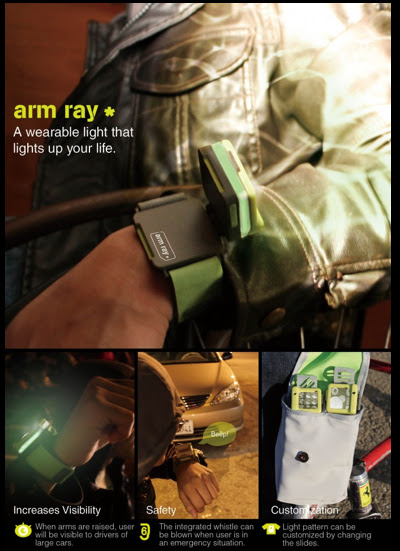
Huge congrats to my CCA student Jean Lin!  Her Arm Ray Wheelchair Lights were deemed notable by the 2012 Core 77 Design Awards for Consumer Products, in the student category.  Jean did this project for ID4, a design studio for juniors, that I co-taught last spring.  The class was asked to create objects that enhance mobile safety, based on design research around a specific user.  Jean chose to study people who use wheelchairs.  And to meet a bunch of them, she found the local wheelchair basketball practice and hung out.  Here's what the judges said:
The jury was particularly impressed with the thoroughness of the research behind ArmRay. Building intimate connections into the user’s life helped establish a design that really answered their needs.
There are still plenty of designers, students and professionals, who see design research as a way to justify what they already wanted to do, rather than inspire new directions.  Jean's  openness to folks with a really different perspective paid off big time.  Way to go Jean!

Wednesday, July 11, 2012

Barbasket Kickstarter Preview


Barbasket from Chris Luomanen on Vimeo.


Tomorrow is the big day, everybody!  Tomorrow my Kickstarter for the Barbasket goes live.  For the last week I've been trying to get the word out to as many people as possible without making too much of a pest of myself.  It took a lot of work to get it to where it is now.  And its going to take a LOT more work to take it to market.  The beauty of Kickstarter is that we won't be bringing it to market without knowing if people like it or not.  Hopefully they do.  Stay tuned!

Student Achievement: Design for Social Impact!

Huge congratulations are in order for Stanford Design MFA and my former teaching assistant at Stanford, Alejandro Palandjoglou.  He just won the student division of Core 77 Design Award for Social Impact .  His project, the Adaptair Pediatric Nasal Interface, which he developed along with a team of medical and business students, is a simple and affordable way to deliver effective respiratory treatment for children who suffer from life threatening illnesses.  I'd say that's a social impact.

In addition to his outstanding problem solving skills, Ale is a gifted form-giver who has an undergraduate degree in ID and had his own furniture company back home in Argentina.  His strong work ethic, hands on approach, sense of humor and good taste represent the best qualities of the Stanford Graduate Design Program.

Way to go, Ale.  You're a star.

Student Achievement: CCA and Wilsonart


I was at NEOCON in Chicago a few weeks ago and was delighted to see the work of two of my CCA students, Jeni Tu and Rosalie Wild featured as runners up in Wilsonart Challenge!  Both of these outstanding designers have bright futures ahead of them.  Jeni's brother, and fellow CCA student, Kaii Tu was the winner of the challenge.  While Kaii was not one of my students, I did a portfolio review with him and his work is impressive.

It really warms my heart to see young talent getting this kind of exposure and recognition.  Huge congrats to all of you.  And it was great running into Kaii and Jeni at the show.  Keep killing it, guys.  

Wednesday, February 15, 2012

Making Things that Matter


You may have read this New York Times article about how the US lost out on iphone work.  It raises fascinating questions about what it takes to be the most desirable manufacturer for the tech industry.  Its not all cost.  Its cost plus flexibility plus precision.

But maybe there are other routes.  Maybe it's possible to make valuable things without their success hinging on making workers live in company dorms and work 12 hour days?

Tech is fleeting.  I have given away an iPhone, and I have a dead one on my desk.  So I'm on my third one in about 4 years.  That creates lots of demand, which is good for business.  But is that the only way?

I recently saw these two videos, shot within a few years of each other, about the manufacture of two products that are WILDLY more valuable today than they were when they were new; the Porsche 356, and Fender guitars.

Porsche 356s, in restored condition are now regularly selling above $100k.  I don't mean special models, just regular coupes and cabriolets.  Fender Stratocasters from the late 50s are selling for $20K-$30k.

What did they have in common?  Transcendent design and beautiful workmanship.  Among the things we make today, how many will be worth more in the future?

Wednesday, February 1, 2012

I, for one, welcome our new robot overlords.

You know that part in the horror movie where somebody does something that more or less gives the monster a perfect opportunity to eat or dismember you?  Skinny dipping alone at midnight.  Making out in a graveyard.  Playing hide and seek in an old abandoned warehouse.  You get the idea.

I feel like I'm watching that part of the movie as robotics scientists at the University of Pennsylvania develop swarming helicopter robots.  I mean what could go wrong with swarms of formation flying nano robots, right?  Oh wait, I have an idea.  Lets make them self replicating and give them a desire for self preservation at all costs.

Its almost as creepy as that chainsaw powered robot dog.

Thursday, January 26, 2012

Peel Away!


As my friends at Edison 2 like to say, the two factors that matter most for fuel economy are weight and aerodynamics.  They should know, they are the  makers of the worlds most efficient four passenger car, according to the Automotive X Prize.

Of course, there's another factor--going slower.  It reduces the influence of aerodynamics, and as owners of very slow cars know, it reduces your blood pressure too.

That's why I was THRILLED to hear that the ridiculously small and underpowered Peel nano-sized car is going back into production!  How'd you like to do your commute in this little baby!

With a top speed of 40mph and 157mpg, this throwback to a simpler (often smarter) time offers insane efficiency, weather protection and the ability to make everyone around you smile.  All while you calm down already.  You might as well--you'll get there when you get there.

You can watch Jeremy Clarkson drive one here.

http://www.youtube.com/watch?v=dJfSS0ZXYdo

Friday, January 20, 2012

Wispr at CES

The response to the Thing Tank designed Wispr portable vaporizer has been overwhelming.  We were honored to be talked about in the New York Times, Wired, Gizmodo, and this in depth article in Core 77.

But we never expected to be picked as best of CES by anybody, let along the blog for the fabulous  Fab.com.  But we were. Read the whole story here.  Oh and we were mentioned in Apartment Therapy's best of CES (though not ranked #1...maybe next time).

Not bad for a product whose only electronic part is an igniter.

Here's a video from Tech Crunch interviewing our pal Jacqueline Oglesby (Hi Jacqueline!) at the Wispr booth.  Looking good.

And of course, Sequitur getting their props on Lovely Package.

Viva la Wispr.

Tuesday, October 18, 2011

I'm ok if you're ok. Ok, stop it.


Is sexual harassment the new Turing Test?  Alan Turing postulated that we can tell if machines could think by whether they act like they can think.  The way his test worked was that...

... a human judge engages in a natural language conversation with a human and a machine designed to generate performance indistinguishable from that of a human being. All participants are separated from one another. If the judge cannot reliably tell the machine from the human, the machine is said to have passed the test. The test does not check the ability to give the correct answer, it checks how closely the answer resembles typical human answers. The conversation is limited to a text-only channel such as a computer keyboard andscreen so that the result is not dependent on the machine's ability to render words into audio.


Siri, Apple's new personal assistant inside the iPhone 4s wants to act like a human assistant.  She doesn't just understand your words she understands your meaning.  Or at least she seems to.  


Wait was I just been referring to a talking box as "she"? 


Jonathan Mann, of song a day fame, raises the stakes by adding inappropriateness to the mix.  Jonathan professes his unrequited love to Siri who reacts with remarkable aplomb.  First she tries to ignores it.  Then she redirects.  She restates her objection.  Then she uses humor to diffuse it.  In short, she acts like a smart woman who is trying to send the right signal to a harasser; "not a chance, dude, get over it."  


In fact, it's Jonathan who comes off as not understanding what the hell is going on here.  Score one for Siri.


Then she starts tossing around mildly obscure cultural references.  Douglas Adams' answer to the meaning of life.  She quotes the first artificially intelligent villain in pop culture, HAL.  She's pretty funny in the face of his creepy behavior.  


But eventually, when Jonathan can't catch a clue, Siri has to lay down the law.  Stop.  Just stop.


Seems like a pretty intelligent response to me.


Thursday, October 13, 2011

Hiding in Plain Sight

We're super excited that the New York Times featured the Thing Tank designed Wispr portable vaporizer in their Style section article "Legal Marijuana Sells Vaporizers."

While our client, Oglesby & Butler cannot make claims about the health effects of vaporization, Dr. Lester Grinspoon, associate professor emeritus of psychiatry at Harvard Medical School can.  He said, “Vaporized marijuana is virtually free of whatever toxic properties come with burning the plant."    


I just wish that the writer, Jed Lipinski, had attributed the design of the object correctly!  They attributed it to Sequitur Creative, our brand/identity/packaging/web partners on the project. 


But the big news here is that the Wispr is a luxury product, aimed at design savy folks.  That's a response to a growing shift in people's attitudes around marijuana use.  Its gone from something you need to squirrel away when you are in decent company, to an accepted part of modern life.  Paper Magazine is picked up on this trend in their recent article linking the Times piece with a recent Gourmet article "Beyond Pot Brownies."    


"Here we learn about pot-infused wine and beer and other delicacies inspired by 'marijuana's culinary trip from wacky weed to haute herb."


Stay tuned for more Wispr news...

Wednesday, October 5, 2011

Shhh...Its here


The Wispr vaporizer from Oglesby & Butler is here!  Thing Tank did the design of the object, and Sequitur Creative did the identity, packaging and website.  Sequitur's awesome work was just honored on The Dieline, the coolest packaging website ever.  

I'll be telling the whole story in an upcoming post, and there's going to be some major coverage coming up, so stay tuned!

Thursday, April 14, 2011

Do we need more chairs? If they're like this, then yes.


There's something about chairs.  How they look and how they work are rather nakedly combined.  There's nowhere to hide in a chair.  Structure, support, material and gesture are all baked together.

Many designers have done their most iconic work on chairs.  But most of the chairs around us are unequivocal garbage.  Here is this everyday thing that we all use, and yet it's done well surprisingly infrequently--especially considering the variety that exists in the world.

The Bouroullec brothers are masters of reinterpreting archetypes in ways that transform them.  Their slow chair dematerializes the Saarinen's womb lounge chair.  Their steelwood rematerializes the hideous plastic patio chair with powder coated steel and ash.  And now their Baguettes Chair for Magis (pics above) takes the gesture of the classic steel folding chair and creates something warm and elegant.  Not exactly what the steel folding chair evokes for most.

They've taken away so much of the chair.  What's left are just 4 solid wood legs, a plywood seat and back plus a secret ingredient.  The magic glue comes from a clever die cast aluminum frame that is neither completely hidden or an eyesore.

While there are no truly original ideas out there, there are an infinite number of recombinations.  That makes the good ones all the more rare and delightful.

Tuesday, April 12, 2011

Happy 50th Birthday Space Flight!


I have been a space junkie from the day I could figure out what outer space was.  Part of that was being lucky enough to be a little kid during the age of the Apollo flights--when space travel was a national event.  Everyone stopped what they were doing and paid attention.  There was a sense that we were witnessing some of the greatest achievements in human history.  And we were.

Having grown up steeped in the imagery and lore of the Apollo program--I'm always amazed at how the Russians did it.  There's the famous story about NASA spending $1M developing a pen that would write in space, and the Soviets brought a pencil.  That sums up so many aspects of the different attitudes and approaches that the US and USSR took towards space flight.  At the end of this video, somebody's marking the site of the landing with a railroad spike and an axe, for pete's sake!  A far cry from getting picked up by a nuclear powered aircraft carrier.

This recent article in the New York Times Magazine really brought to light how wildly different the two worlds were.  There was no countdown--just a warning that "after the one minute readiness is announced, there'll be about six minutes before you actually take off."  ABOUT SIX MINUTES?  Wow.  Read the article to learn how Vladimir Komarov, a later cosmonaut, knew he was being sent to his death because the rocket was unsafe.  Not exactly Apollo 13!

But its invaluable to remember that fear of Sputnik and Gagarin created the boom in scientific education in the United Staes, and the subsequent boom in science and technology that brought us to the future.  Internet anyone?

Obama has been talking about how renewable energy could be our Apollo.  Emphasis on could.  Its not yet.